Understanding Active Share, Concentration Risk, Diversification, Volatility - And Their Interaction
How to Better Align Your Investment Portfolios with Your Investment Objectives


A well-constructed investment portfolio is defined by several measurable characteristics. Among the more important are Active Share, Concentration Risk, Degree of Diversification, and Total Portfolio Risk, as measured by for example volatility. Understanding how these features interact can help investors make more informed decisions and better assess the risk-return profile of their investments.
The Four Key Features Explained
Active Share
Active Share quantifies how much a portfolio’s holdings differ from its benchmark index. A high Active Share indicates that the portfolio manager is taking positions that are meaningfully different from the index, while a low Active Share suggests the portfolio closely tracks the benchmark.
Concentration Risk
Concentration risk refers to the extent to which a portfolio’s assets are focused in a small number of holdings or sectors. High concentration means a significant portion of the portfolio is invested in a few assets, increasing exposure to idiosyncratic risk. Low concentration implies the portfolio is more evenly distributed across many holdings.
Degree of Diversification
Diversification measures how broadly a portfolio is spread across different sectors, regions, or asset classes. High diversification can reduce the impact of any single asset’s poor performance, while low diversification increases vulnerability to sector- or asset-specific events.
Total Portfolio Volatility
Volatility is a statistical measure of the dispersion of returns for a portfolio. High volatility means the portfolio’s value fluctuates widely over time, while low volatility indicates more stable returns.
Examples of High and Low Combinations
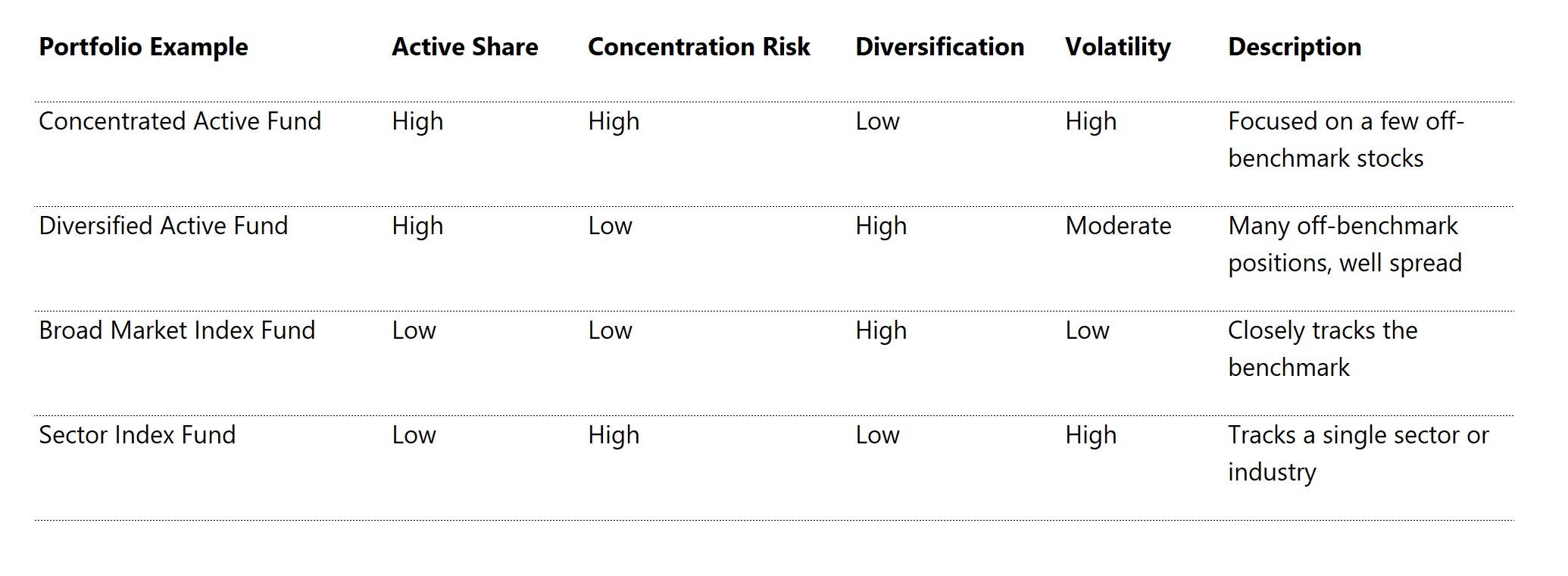
The following table summarizes how these features can combine in different types of portfolios:
Relationships and Implications
Active Share and Concentration Risk: High Active Share often corresponds with higher concentration, but it is possible to have high Active Share with low concentration if the portfolio is diversified across many off-benchmark positions.
Diversification and Volatility: Greater diversification generally leads to lower volatility, as risks are spread across more assets. Low diversification can increase volatility, especially if the portfolio is concentrated in volatile sectors.
Active Share and Volatility: A high Active Share portfolio may have higher volatility, especially if it is also highly concentrated. However, a diversified active portfolio can moderate volatility while still differing from the benchmark.
Conclusion
Active Share, Concentration Risk, Degree of Diversification, and Total Portfolio Volatility are fundamental features that define a portfolio’s structure and risk profile. Understanding these characteristics—and how they interact—can help investors align their portfolios better with their investment objectives and risk tolerance.